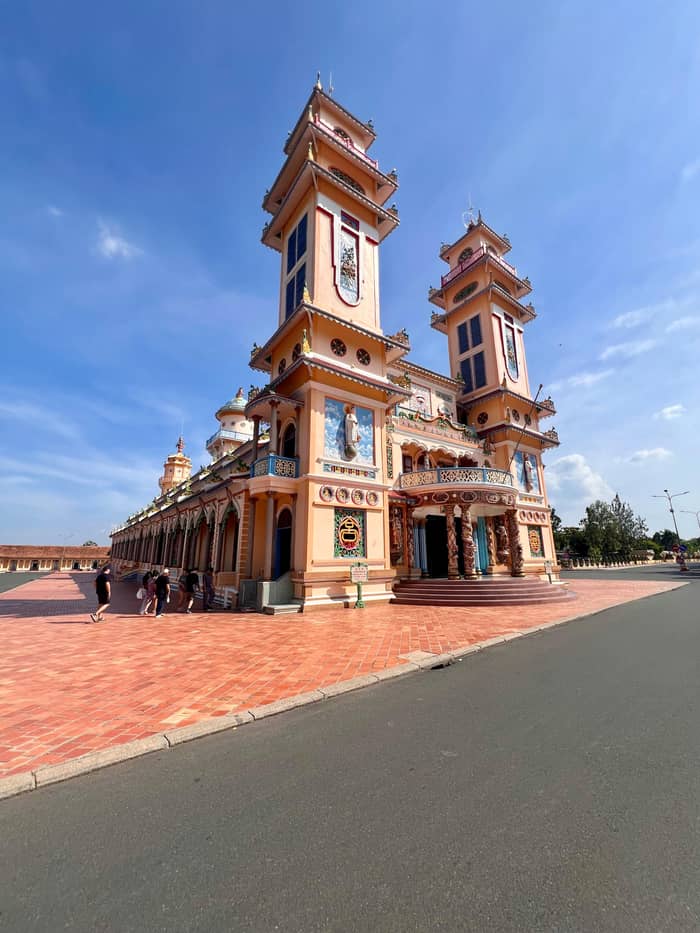
Shared
Timed shared day
Temple at noon
- Temple12:00 to 12:40 PM
- Start07:00 AM
- Reviews387
Tick-off checklist
Tay Ninh day from Ho Chi Minh City
★ 4.7 · 476 reviews total
9-item checklist
Check off each item as you go. Your progress stays saved on this device.
0 / 9 ready
Ready to go. Pick your date for the Holy See, and the rest is settled.
Claim a spotMost people come to the Holy See for half an hour of the day. This page explains when the services run, what the hall looks like, what visitors may and may not do and how to reach it on time.
Editorial team, caodaitemple.top · Updated November 16, 2026 · ~7 min read
In brief
Services are held at the Cao Dai Holy See in Tay Ninh every day for its followers, and the one at noon is the one visitors know. The provincial tourism portal gives 12:00 as the principal service,6 and Vietnam Airlines' guide marks noon as the main one in its own schedule.3 A local guide, quoted by the Viet Nam News feature, names that session the favorite of tour groups.7
The services are for the faith, not for an audience. Nhan Dan says Cao Dai followers have 4 service hours every day,2 and Vietnam Airlines names them as morning at 6:00, noon at 12:00, evening at 18:00 and an additional service at 9:00.3 A visitor who arrives at noon is therefore watching a regular part of worship, one that would happen with or without a camera nearby.
The expectation to carry is simple: be respectful and be early. The sources describe a daily rhythm of prayer in a working religious center, and the Holy See itself stays open from 6:00 to 22:00.8 That long opening day means you can spend the hours before noon in the compound, rather than rushing to the doors, and you can stay after the service when the hall is quieter.
Side by side
| Service | Time | What is said |
|---|---|---|
| Morning | 6:003 | Listed by Vietnam Airlines3 |
| Additional | 9:003 | Listed as an additional service3 |
| Noon | 12:003 | The main service of the day6 |
| Evening | 18:003 | Listed by Vietnam Airlines3 |
Times as Vietnam Airlines lists them; the provincial portal confirms only the main service at noon.3,6
No official page we read describes a marked area for visitors. What they offer instead is a short list of rules. Nhan Dan reports that during ceremonies the main hall admits only Cao Dai followers,4 and that, by regulation, the right-hand door serves men and the left-hand door serves women.2 Vietnam Airlines' guide adds that visitors should skip the main door and take one of the two side doors.9
Shoes are where the official pages disagree, so ask on the spot. The provincial portal says footwear is not carried inside,6 while the airline's guide only tells visitors to leave sandals out of the main hall.9 The national tourism authority's rule for temples is simpler: modest clothing, shoes and hat off, and you may carry the shoes in your hand.10 Do what the attendant at the door asks.
The practical answer to where to stand is to follow the attendants and the people around you. If you have a guide, ask them to point out where visitors gather before you go in, and keep clear of the aisles and doors that the congregation uses. Arriving before the service gives you the choice of spot, and arriving late gives you whatever is left at the edge.
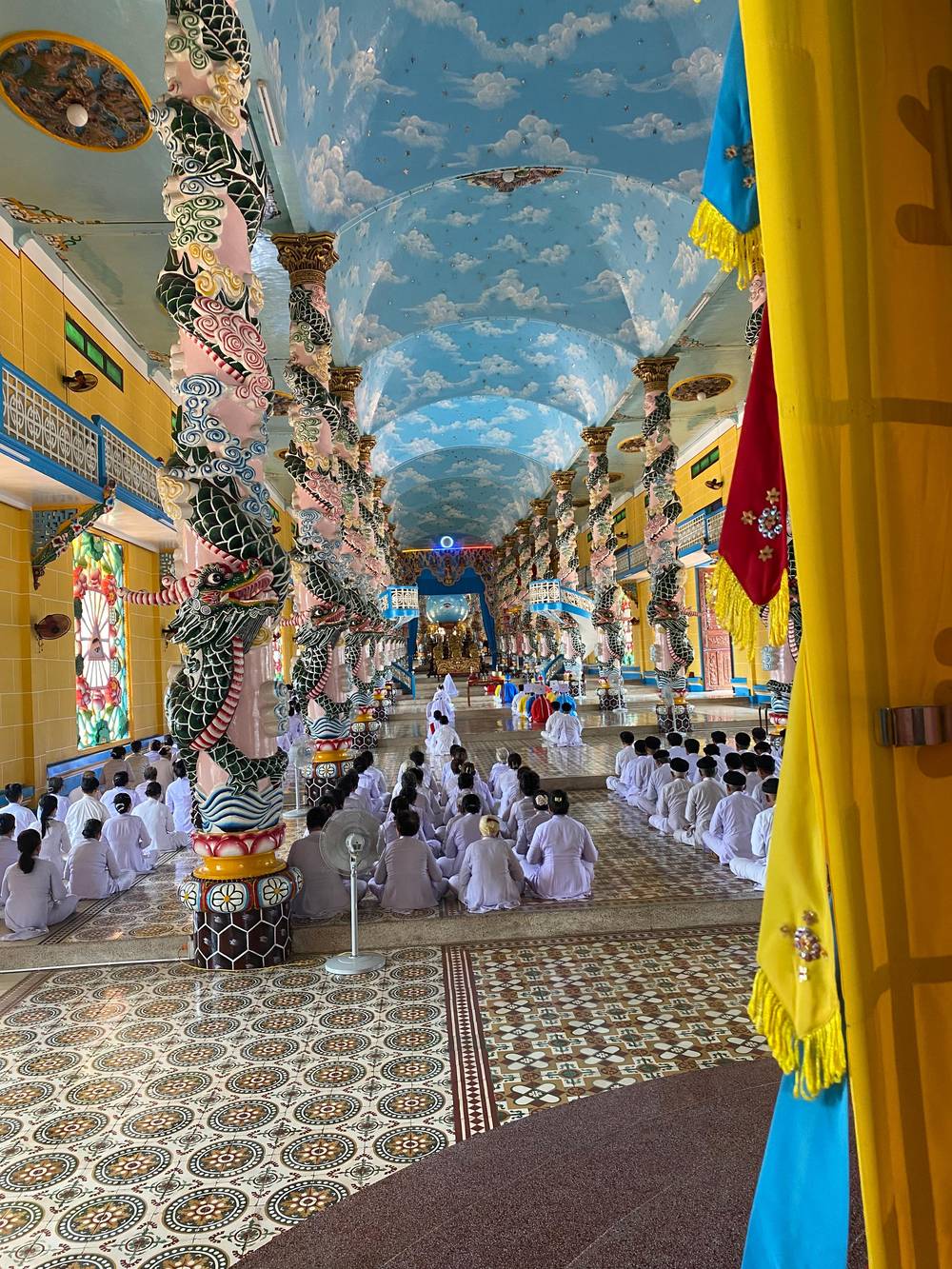
The Cao Dai Great Temple interior is part of what makes the noon service worth the trip. Nhan Dan measures the main hall, Cuu Trung Dai, at 81 metres by 27, with 18 dragon-carved pillars set in two lines.12 Those lines mark out 9 compartments, and during worship each rank of dignitary and follower stands in a separate place matching their standing in the religion.15
Look up before you look around. Stars and clouds are painted across the ceiling to stand for the heavens, and the bagua area at the far end holds a celestial sphere 3.3 metres across that stands for the religion's cosmology.13 Viet Nam News Agency's feature adds that the giant star-speckled globe under the dome is painted with the Divine Eye, the official symbol of Caodaism.16 The ceiling and the globe are the two things worth finding first.
Take in the interior at the pace of the service. The colors are strong, the pillars are glossy and the congregation is in a pattern that the architecture was built to hold. If you have read about the hall beforehand, you will recognise the globe and the pillars at once, and it is the order of the people that is the surprise, because it follows the 9 compartments.
Plan for it
Say how you travel and read off the plan that reaches the service.
If I am joining a shared day
Ask for the arrival hour
One listing schedules the Holy See from 12:00 to 12:40 PM.
If I am booking a private day
Ask for the temple first
A private day starts at 08:00 AM and visits the temple first.
If I am traveling alone by road
Leave early
With the journey at 2 to 2.5 hours, count backwards from noon.14
If I want a day built on the holy mass
Check the listing
Holy mass listings start from $65 and $67.
If I want to see the hall without the service
Come after the service
The compound stays open between 6:00 and 22:00 every day.8
Ways to the noon hour
Shared
Temple at noon
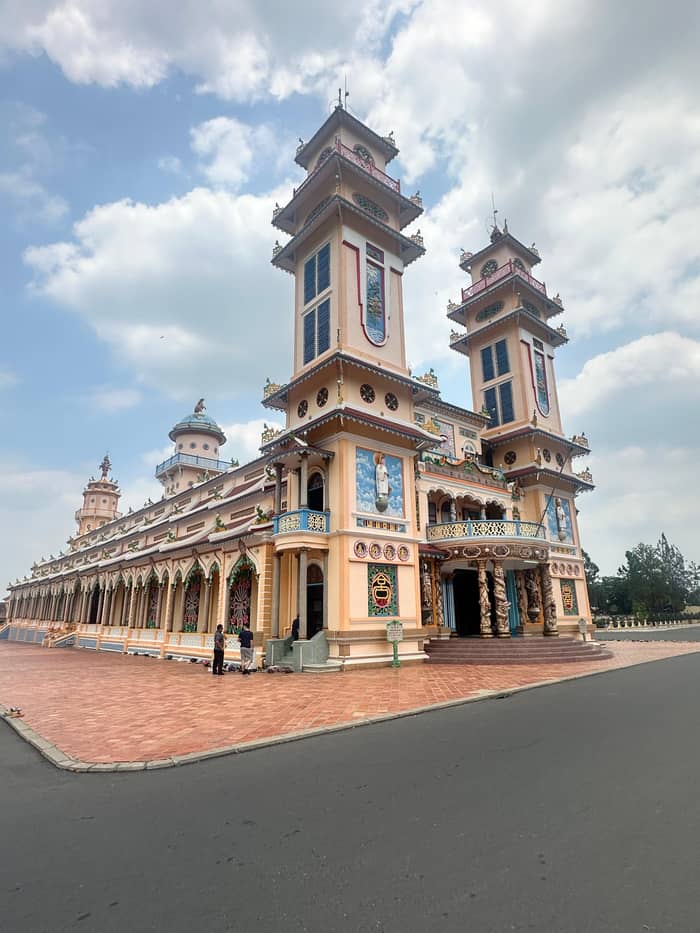
Booked here
Tunnels first
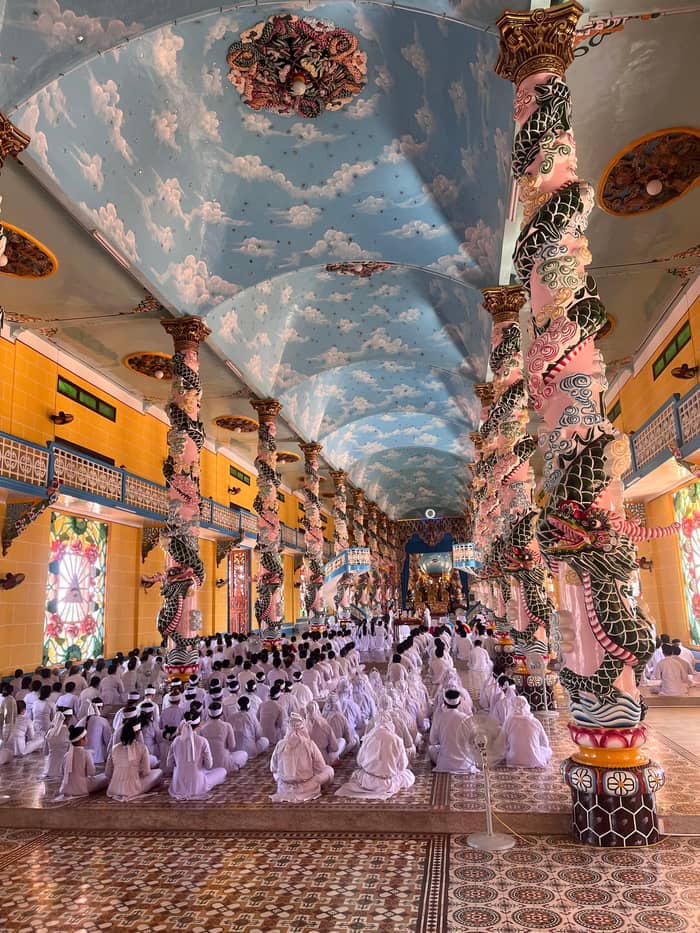
Private
Noon ceremony listed
At the noon prayer ceremony hundreds of followers put on white, yellow, blue and red robes and chant in unison, according to the operator of the Ba Den Mountain resort.20 The same article describes a floor layout that reflects the hierarchy of the religion, which fits Nhan Dan's account of positions that match each rank.21,15 None of the pages explains the meaning of each color, so we leave that to the guide you may have beside you.
The worship is made of chanting, music and ritual movement, and it can feel less like a performance than like a family at prayer. The festivals the Holy See is known for take this further: the Supreme Being Festival falls on the 9th day of the 1st lunar month, and the Dieu Tri Cung Banquet Festival on the 15th day of the 8th lunar month.22,23
Do not expect a program. A service is not timed for tourists, and the length of what you see depends on the ritual of the day. This is why planning your arrival early matters more than planning to leave on the dot. If your group has a fixed pickup time, tell the guide you want to stay for the whole service and agree on a meeting point well away from the entrance.
Price your group
Enter the size of your group and compare what four Holy See days would cost.
Side-by-side: 4 options
Enter the size of your group and compare what four Holy See days would cost.
≈
View≈
View≈
View≈
ViewStarting prices from GetYourGuide, converted at the ECB reference rate. You will see the exact price when booking.
A day of services
Early morning
Vietnam Airlines lists a morning service at 6:00.3
Late morning
The same guide lists an additional service at 9:00.3
Noon
Noon at 12:00 is marked as the main service of the day.3
Evening
An evening service is listed at 18:00.3
All day
The Holy See opens from 6:00 to 22:00 daily.8
Whether a day tour reaches the ceremony comes down to its schedule. One timed shared listing fits the Holy See into a midday slot that ends at 12:40 PM, after the mountain and before lunch and the tunnels. The Tay Ninh shared day mentions a chance of the daily prayer for guests who arrive near 12:00 PM. Ours words it as a possibility that depends on timing, and warns that the order of stops may change.
Two private listings go further. A private 9-hour tour of Cu Chi and the Cao Dai Temple lists the noon ceremony in its highlights, and a private 11-hour day of the Cao Dai Temple and Cu Chi lists the midday ceremony among its highlights, with a start at 08:00 AM so the temple comes first. Two other listings, one from $65 and one from $67, are built around a holy mass.
Whichever you choose, ask the operator one question before you pay: at what time does the group enter the Holy See? A vague answer is a sign that the ceremony is a bonus, and a clear one is a sign that the day is planned around it. A guide who knows the Tay Ninh Cao Dai temple interior can also tell you where the group may stand. The answers matter more than the title of the listing, because titles promise and itineraries commit.
Video
For 91 Days - Slow Travel Adventures on YouTube · Video data is requested only when you tap play.
Only Cao Dai followers are allowed to enter the main hall during the ceremonies.
Vietnam Airlines' guide asks visitors to ask the attendants for permission before they light incense, film or take photos.17 The national tourism authority gives a wider habit worth adopting everywhere in Vietnam: ask before you lift the camera when people are in the frame.19 During a service, the worshippers are the subject of the room, so photographing them without a thought is the quickest way to cause offense.
The grounds have rules of their own. The guide forbids drawing, writing on or touching the walls and artifacts of the complex.18 It also notes that Bat Quai Dai, the most sacred space behind the main hall, is closed to the public and reserved for clergy.24 Keep to the paths and the public areas and the visit will go smoothly for everyone.
Keep voices low, phones silent and hands to yourself. Dress as you would for any place of worship, covered at the shoulders and knees, which is what the guide advises for the main hall.17 A hat in your hand, a quiet question to the guide and a patient place near the wall are all that is needed. The reward is a service you can follow with respect and without a lens between you and it.
FAQ
Only followers may enter the main hall while a ceremony takes place, says Nhan Dan.4
According to Vietnam Airlines, Vietnamese and foreign visitors alike enter free.5
Attendants should be asked for permission before any filming or photographing.17
One listing schedules the temple from 12:00 to 12:40 PM, while ours says it depends on timing.
Sources
Planning a day to the Cao Dai temple from Saigon? Ask a real person here.