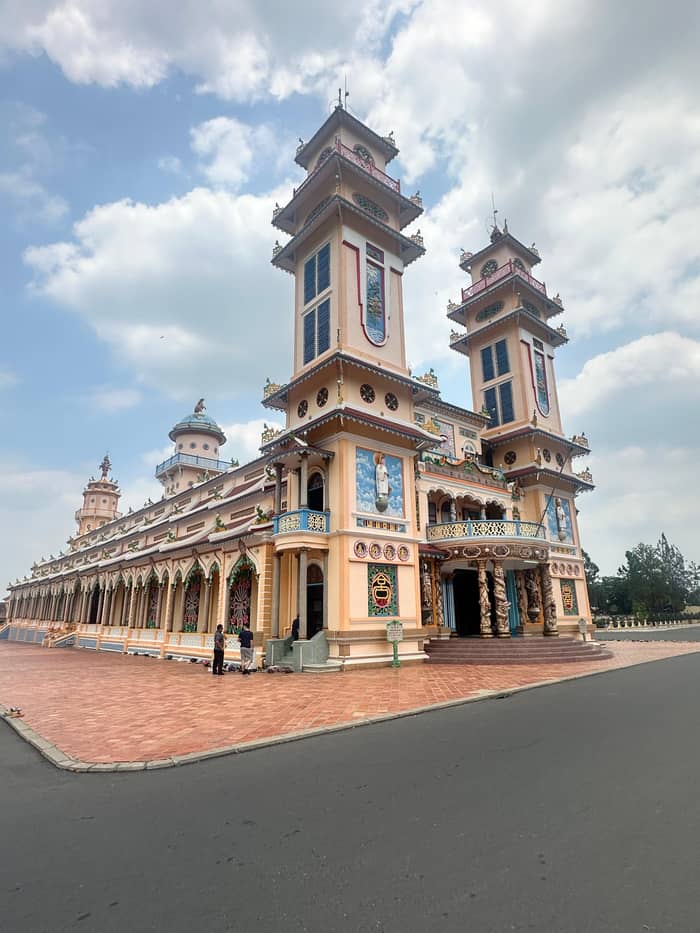
Holy See
Our site day
The Holy See with the mountain
- At the temple2 hours
- Day length12 hours
- Reviews476
Choose your stop
Check out 18 stops
Pick a route and tap a pin or a stop: you get its note and a Google Maps link.
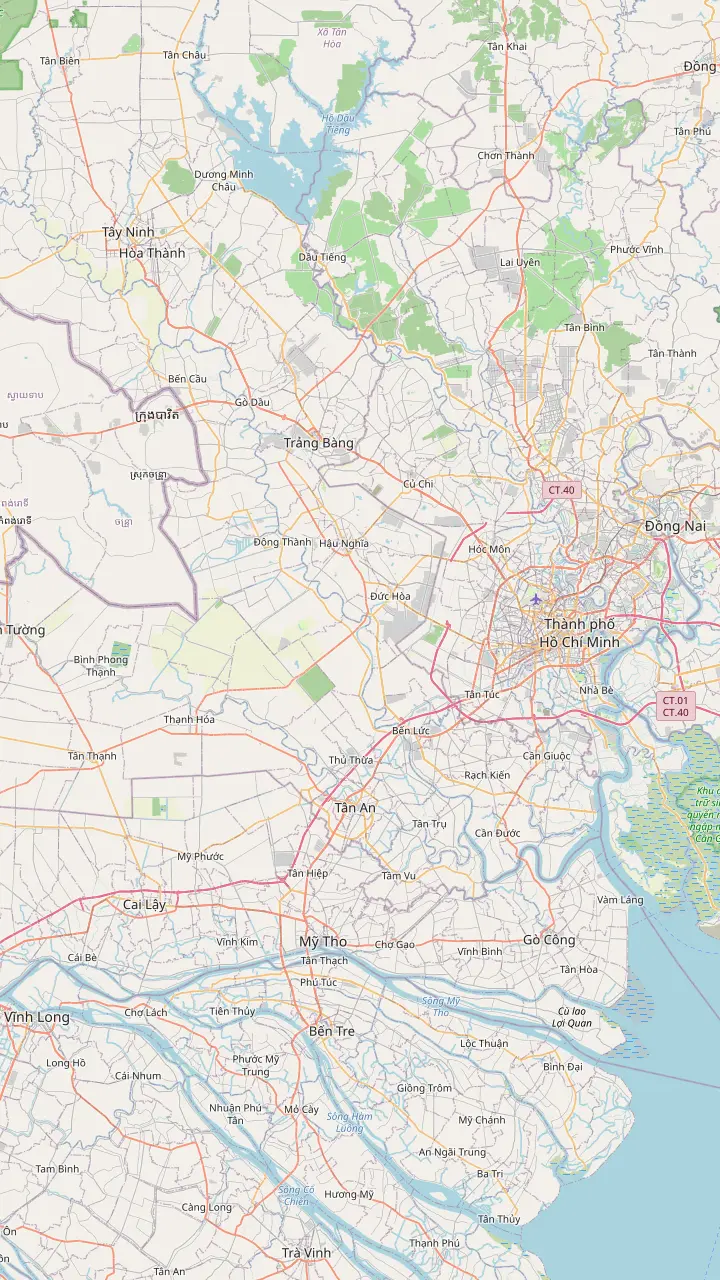
Nam Thanh Holy Temple, formerly Cau Kho, is recognised as the birthplace of the religion.
Google MapsA Cao Dai oratory in the Cho Quan ward, in the south-west of the city centre; the places a visitor can enter are decided by each oratory.
Google MapsBen Thanh Market in District 1 stands in for the pickup area that day tours use in the city centre.
Google MapsThe Holy See is the heart of Caodaism, considered the religion's birthplace.
Google MapsA Cao Dai oratory in Vinh Long province affiliated with the Tay Ninh Holy See, as its name on the map records.
Google MapsA second oratory in Vinh Long province affiliated with the Tay Ninh Holy See, as its name on the map records.
Google Maps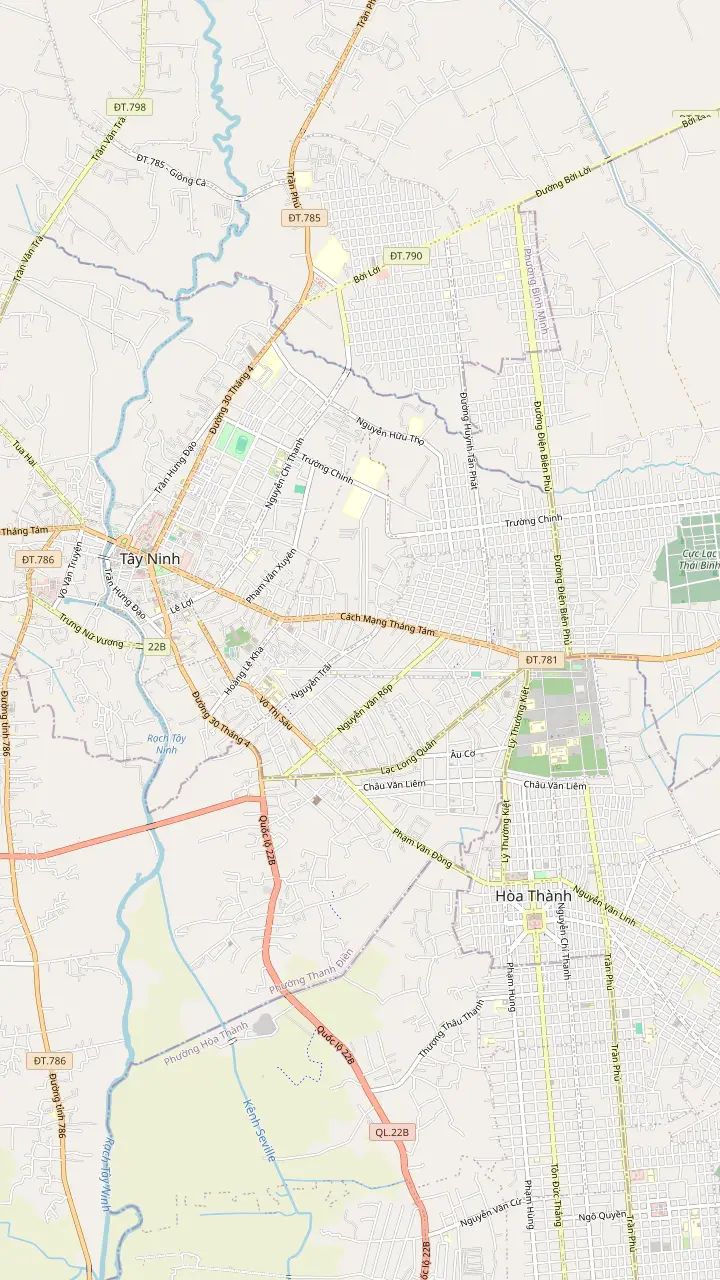
The Holy See is the heart of Caodaism, considered the religion's birthplace.
Google MapsOne of the numbered gates of the Holy Land; the compound has 12 surrounding gates.
Google MapsTay Ninh city lies about 5 km from the Holy See, the distance the state press gives.
Google Maps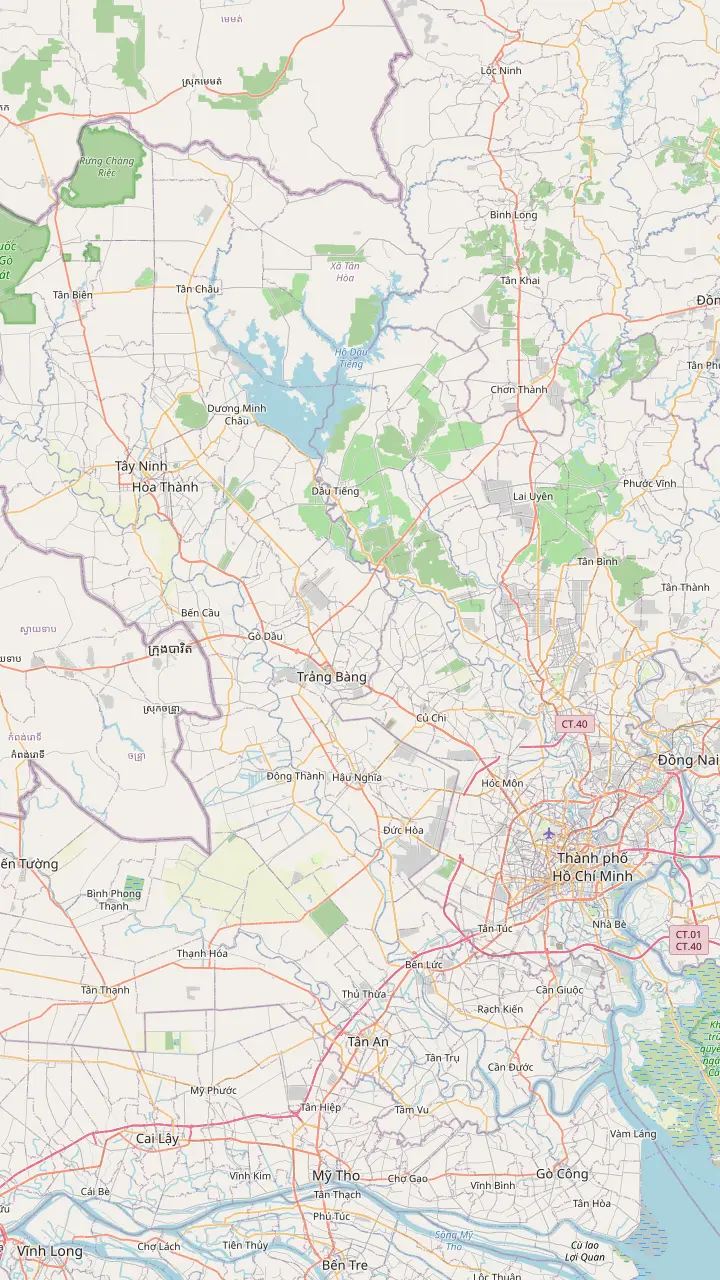
Ben Thanh Market in District 1 stands in for the pickup area that day tours use in the city centre.
Google MapsThe Ben Duoc tunnels of Cu Chi, a stop on some day tours that combine Tay Ninh with the tunnels.
Google MapsTay Ninh city lies about 5 km from the Holy See, the distance the state press gives.
Google MapsThe Holy See is the heart of Caodaism, considered the religion's birthplace.
Google MapsBa Den summit stands 986 meters above sea level, with the Lady Buddha statue on the peak.
Google Maps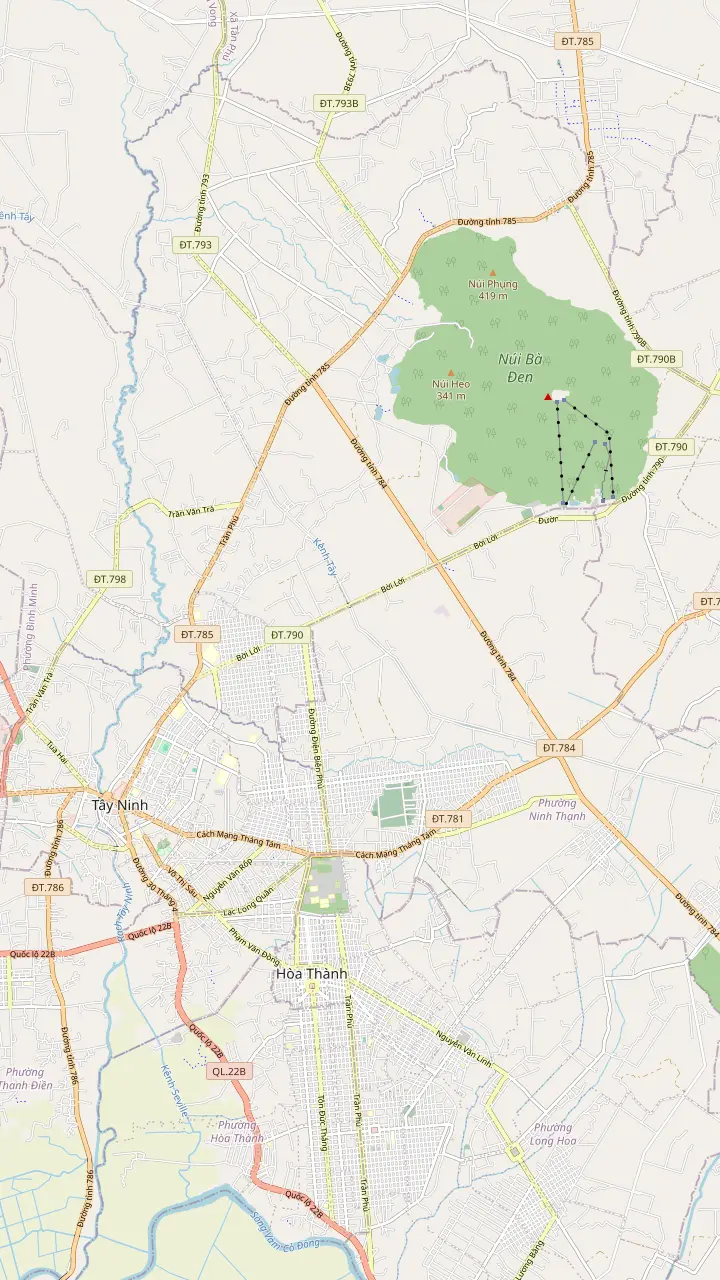
Tay Ninh city lies about 5 km from the Holy See, the distance the state press gives.
Google MapsThe Holy See is the heart of Caodaism, considered the religion's birthplace.
Google MapsThe Ba temple complex halfway up the mountain, where a cable car line and a stepped path arrive.
Google MapsBa Den summit stands 986 meters above sea level, with the Lady Buddha statue on the peak.
Google MapsMap data from © OpenStreetMap contributors
There is no Holy See inside Ho Chi Minh City. This guide separates the Tay Ninh Holy See from the Nam Thanh temple in Saigon and the many smaller oratories, with a map and a table of which to visit.
Editorial team, caodaitemple.top · Updated November 16, 2026 · ~7 min read
In brief
Searches for a Cao Dai temple in Ho Chi Minh City usually mean the great temple with the two towers, and that building is not in the city. It stands in Tay Ninh province, a few kilometres out of Tay Ninh city (the national portal says about 5 km), and Tay Ninh lies roughly 100km from Ho Chi Minh City.2,1 Vietnam News Agency calls the Tay Ninh Holy See the heart of Caodaism, considered the religion's birthplace, while the Saigon oratory is also called the birthplace, so the sources use the word in more than one sense.9,3
The city does have Cao Dai temples, which is why the confusion arises. One documented temple is the Nam Thanh Holy Temple, in Cau Ong Lanh ward, where a ceremony for the 100th anniversary of the founding was held on the morning of October 3rd.10 Other, smaller temples stand in the districts, and one mapped as the Saigon Holy Temple lies in Cho Quan ward; no official source used here gives visiting hours or rules for these, so ask locally before you go.
The practical rule is therefore short. If you want to see a Cao Dai service with visitors, a temple the tour industry already visits, and a building of the scale in the photographs, the destination is the Holy See in Tay Ninh. If you want the story of the religion in the city where it began, Nam Thanh is the place to read about. The map on this page puts both on one frame, with the road between them.
Which is which
| Place | What it is | For a visitor |
|---|---|---|
| Tay Ninh Holy See | The central place of worship of Caodaism9 | Services four times a day, main hall closed to non-followers in ceremonies21,22 |
| Nam Thanh Holy Temple, Saigon | Formerly Cau Kho, recognised as the birthplace3 | No visitor hours in the sources; ask the board |
| Saigon Holy Temple, Cho Quan | A temple mapped in the Cho Quan ward | No visitor information in the sources |
| Oratories in Vinh Long | Mapped as affiliated with the Tay Ninh Holy See | Local congregations; ask before going |
| Cai Be Cao Dai stop | A photo stop on a Mekong day listing | 30 minutes in a private 10-hour day |
Only the Holy See has published service times in the sources used here; the other rows are for orientation, not for planning.21
Nam Thanh Holy Temple carries a historical claim. Viet Nam News, citing the news agency, regards Nam Thanh, once called the Cau Kho oratory, as the religion's birthplace, and Vietnam.vn calls it considered the earliest temple of the Cao Dai religion, an indigenous religion of Vietnam.3,15 Vietnam.vn describes the temple as looking back on its journey from Cau Kho Holy Temple, tied to the early formation of the faith.16
Vietnam.vn also describes a second ceremony in Ho Chi Minh City, on October 14, organised by the Management Board of the Southern Citadel, where Nguyen Huu Nhon, chairman of the Nam Thanh board, recalled the first General Assembly held at Cau Kho Holy Temple exactly 100 years before.17,18 A Cao Dai scholar quoted by the portal likens Nam Thanh to the Bethlehem cave where Jesus was born, and the Tay Ninh Holy See to the Vatican.19 The two temples are presented side by side, not as rivals.
Nam Thanh is also described as a working community. The news agency says its followers have taken part in social welfare, giving free medical check-ups to persons with disabilities and the elderly, along with gifts and scholarships to underprivileged students.20 As a visitor you should treat it as a place of worship in a busy city district, with no confirmed visitor programme in the sources used here, and ask the board before you arrive.
English names for Cao Dai temples in Vietnam differ by writer, and that is a source of confusion. The news agency calls the Saigon building an oratory, the national portal calls it a holy temple, and the Tay Ninh complex is called the Holy See in every source.3,16,9 In Vietnamese usage the terms mark rank: a thanh that is an oratory, a toa thanh that is the seat of a church. Use Holy See for the great central complex and temple or oratory for the smaller buildings.
Counts of buildings explain the range. Voice of Vietnam puts the places of worship at 1,000, the news agency at 1,300 across 37 provinces and cities.4,5 One church figure lists 402 temples besides 163 other places of worship in 39 cities and provinces.6 The totals depend on what each source counts as a temple, so quote the number with its source and avoid adding one figure to another.
A visitor will meet only a few of them. The oratories of a province serve local followers, while the Holy See receives visitors in numbers, drawing 100-200 foreign tourists a day according to Viet Nam News.23 That figure comes from the Tay Ninh archbishop and refers to foreign visitors only, and the sources used here give no visitor figures for the other temples. Treat a visit to one of them as a request to a community, not as a ticketed sight, and let the congregation set the terms.
Where to go
Choose what you want and see which temple answers it.
If A service and a big building
Tay Ninh Holy See
It holds services four times a day and the noon one suits tour groups.21,8
If The birthplace in the city
Nam Thanh, Saigon
The news agency recognises it as the birthplace of the religion.3
If One day from Saigon
A Tay Ninh day tour
Our listing gives the Holy See 2 hours in a 12-hour day.
If A small local oratory
Ask the congregation
Visitor hours for the smaller temples are not published in the sources.
If The Mekong side
A Cai Be day
One private listing gives its Cao Dai stop 30 minutes.
Ways to see a Cao Dai temple
Holy See
The Holy See with the mountain
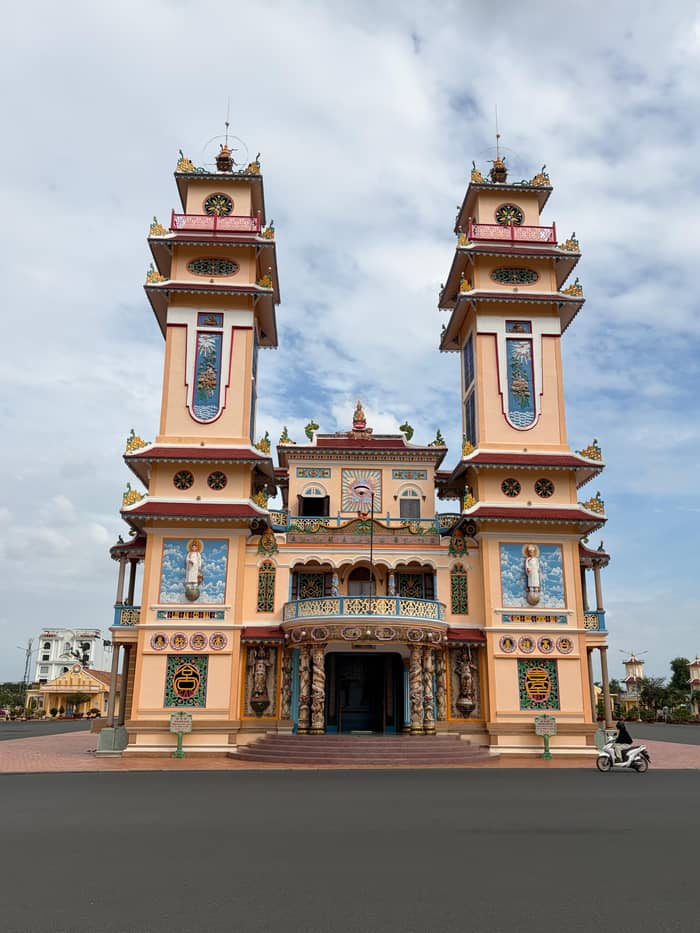
Holy See
Temple before the mountain
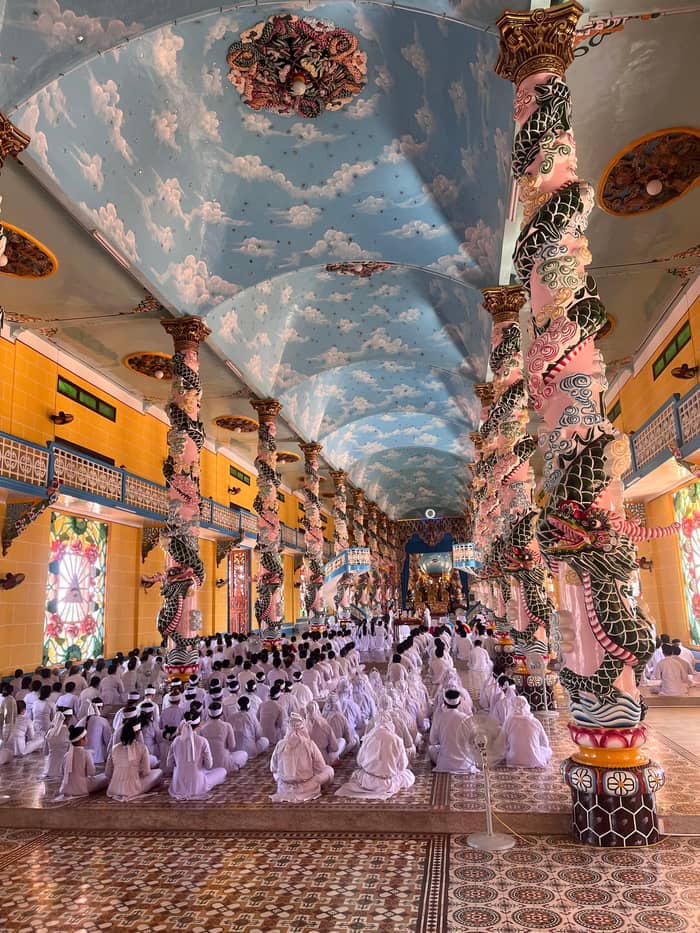
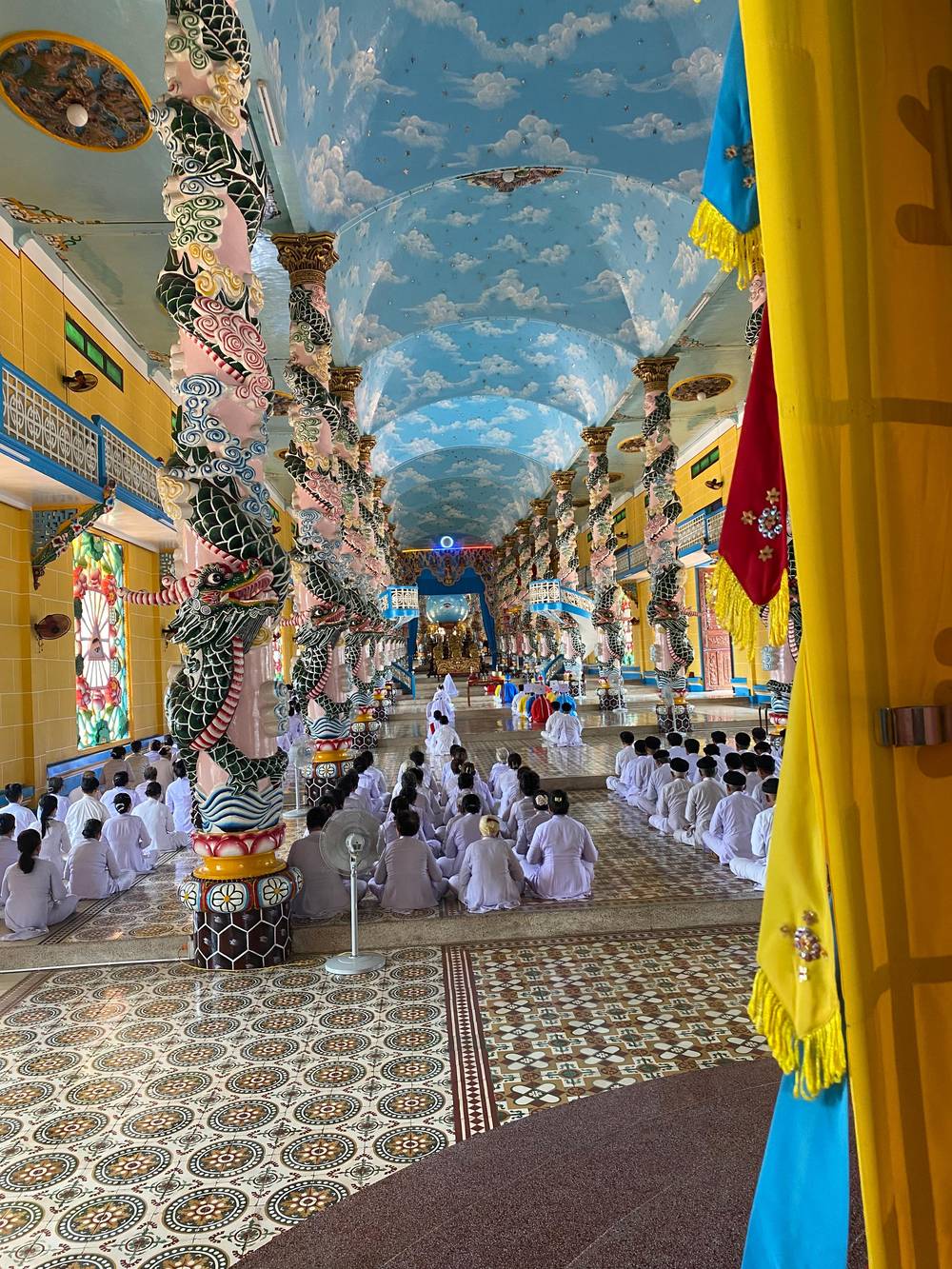
Delta stop
A private Mekong day
The Cao Dai religion is divided into branches, and the state treats them as separate bodies. Vietnam.vn counts 10 recognized congregations plus one practice method and a few independent establishments, with the Tien Thien branch recognised in 1995 and the Tay Ninh branch in 1997.7,14 Each congregation is listed on its own, so a temple belongs to one of them and it is worth asking which.
The Nam Thanh temple's own name points to one of them. The same list gives the Cau Kho and Tam Quan Congregation as recognized in 2000, and Cau Kho is the former name of the Nam Thanh temple.14,3 A separate congregation, Minh Chon Dao, has a College of Women whose delegation was received by the Vietnam Fatherland Front in Hanoi.29 The table below sets the recognised congregations side by side.
Dates differ among branches too. Vietnam News Agency reports that most dignitaries and followers keep the founding on the 15th day of the 10th lunar month, whereas several sects, among them the Nam Thanh oratory, keep the 23rd day of the eighth lunar month.30 When you read a festival date for a temple, ask which congregation it belongs to, because the festival calendar of the Tay Ninh church, with Duc Chi Ton in the first lunar month and Yen Dieu Tri Cung in the eighth, is only one of them.31
Price your visit
Add your travellers and compare the shared days side by side.
Side-by-side: 4 options
Add your travellers and compare the shared days side by side.
≈
View≈
View≈
View≈
ViewStarting prices from GetYourGuide, converted at the ECB reference rate. You will see the exact price when booking.
How the network grew
1926
A founding report went to the government.11
1931
The Holy See was started in 1931 in Tay Ninh province.12
1955
Viet Nam News says the Holy See was officially inaugurated in 1955.13
1995
The Tien Thien Congregation was recognized by the State in 1995.14
1997
The Tay Ninh Congregation was recognized in 1997.14
The centenary
Nam Thanh Holy Temple held a ceremony on October 3rd for the 100th anniversary.10
Beyond Saigon the pattern repeats on a smaller scale. A map of southern Vietnam places oratories in Vinh Long province whose names mark them as affiliated with the Tay Ninh Holy See, My Thanh and Tien Thuy, and a Saigon temple in Cho Quan ward. No source used here describes these buildings, so treat the pins as places to know about rather than stops to plan around, and ask the congregation before you go.
Day tours touch the delta only lightly. A private 10-hour listing from Ho Chi Minh City to Cai Be in the Mekong gives its Cao Dai Temple stop 30 minutes as a photo stop, between a 2.5-hour drive and the floating market. That is a different experience from the long visit at the Holy See, where our own listing spends 2 hours. If the Mekong is your main aim, look for a tour built around it, since this site stays with Tay Ninh.
Overseas, the religion is smaller. The news agency has given about 30,000 followers living overseas, and communities abroad run temples of their own, which this page does not cover.5 The names and the buildings are similar, but the congregations, the calendars and the rules belong to each community. If you are searching from outside Vietnam, look for the local congregation by name. For Vietnam itself the answer is the Holy See in Tay Ninh, with Nam Thanh as the historic house in Saigon.
Video
Vietnam Travel on YouTube · Video data is requested only when you tap play.
Nam Thanh Holy Temple is considered the earliest temple of Cao Dai religion, an indigenous religion of Vietnam.
Before you choose
For most visitors the answer is the Holy See. Services take place four times a day, and the noon session suits the tour groups best, as Viet Nam News relates.21,8 During ceremonies the main hall stays with the followers, and visitors watch from the places the staff set aside.22 That arrangement belongs to the visit and does not get in its way: you see the robes, hear the chanting and understand why the building is arranged as it is. A day tour from Ho Chi Minh City can combine the temple with the mountain.
Our own listing gives the Holy See 2 hours inside a 12-hour day and costs from $61. A shared listing covers Tay Ninh and the mountain from $53, and another day from $55 puts the temple after the mountain with 45 minutes there. Compare the time at the temple, the pick-up and whether the cable car is included, and choose a day that reaches the Holy See before the noon service ends.
To go further than the Holy See, plan a separate visit. Ask the Nam Thanh board whether visitors are welcome, check the temple's congregation and the lunar calendar before you set a date, and dress and behave with the respect that a place of worship in Vietnam asks for. A temple is a living community first and a sight second, and the polite visitor is the one who is invited back. Bring a small gift of fruit only if the congregation invites you to, and never leave money without being asked.
FAQ
The religion has 10 state-recognized congregations and one practice method.7
The sources used here give no visitor hours for them, so contact the temple before going.
Viet Nam News says the noon service there is most popular with tour groups.8
Sources
Planning a day to the Cao Dai temple from Saigon? Ask a real person here.