Long visit
Our site day
A long stop at the temple
- At the temple2 hours
- Day length12 hours
- Reviews476
Decide with ease
Two questions, one day
Say what you want from the visit and the day that fits appears with its starting price.
Your top pick
from $54
An 11-hour trip from Ho Chi Minh City to Ba Den and the Cao Dai Temple with lunch, with the cable car extra.
Your top pick
from $61
A 12-hour day with the Cu Chi Tunnels, the Cao Dai Temple for 2 hours and the mountain for 1.5 hours.
Your top pick
from $55
A day with 2.5 hours at Black Virgin Mountain including a cable car ride, then the temple for 45 minutes.
A plain account of a faith started by Vietnamese people in Tay Ninh in 1926: who founded it, what it borrows from other religions, what the Divine Eye stands for and how many followers it has.
Editorial team, caodaitemple.top · Updated November 16, 2026 · ~7 min read
In brief
What is the Cao Dai religion? It is a religion that began in Vietnam, and Vietnam.vn describes it as started by Vietnamese people in Tay Ninh province in 1926.1 Its central idea is easy to state: it takes the spirit of several great traditions and joins them. The national portal says Cao Dai combines Buddhism, Taoism, Confucianism and Christianity, and that besides the Divine Eye it honours the Buddha, Jesus Christ, Confucius, Lao Tzu, and Quan Am, known as the Goddess of Mercy.2
That mixture is what a visitor notices first, and it is also what the official summaries stress. A report on the religions recognised by the State calls the synthesis of doctrines and laws from other religions a distinctive feature of Caodaism, and it notes that the objects of worship include gods, Buddhas, saints, Jesus Christ and famous figures such as Victor Hugo.9 So what is a Cao Dai temple? It is not a pagoda or a church but a building that borrows from several and answers to none of them.
The Government's Religious Affairs Committee counts Cao Dai among the religions recognised or registered by the State, and the same report calls it an indigenous religion.7 The Holy See page of the national portal adds that the faith ranks 4th among 16 recognised religions in Vietnam.10 The sections below follow the faith in the order a visitor meets it: where it started, who founded it, what its symbols mean and how many people belong to it.
Recognised branches
| Congregation | Recognised | Note |
|---|---|---|
| Tien Thien | 199514 | The earliest on the list.14 |
| Minh Chon Dao | 199614 | Its College of Women was received by the Fatherland Front in Hanoi.22 |
| Chieu Minh Long Chau | 199614 | Listed with the others of that year.14 |
| Tay Ninh | 199714 | The church of the Holy See.5 |
| Ban Chinh Dao | 199714 | Recognised in the same year as Tay Ninh.14 |
| Cau Kho and Tam Quan | 200014 | Name shared with Cau Kho, the former name of Nam Thanh.6 |
The list is the national portal's account of the congregations; later recognitions exist.23
The founding is dated to 1926, though different groups mark it on different days.4 Vietnam News Agency quotes the head of the Nam Thanh church on how it began: Le Van Trung, then the leader of Caodaism, and 247 Caodaists informed the government of the new religion on the 23rd day of the 8th lunar month in 1926, which became its founding day.4 The same agency notes that most dignitaries and followers hold their anniversary on day 15 of the 10th lunar month.16
Two places claim a share of the beginning. Local officials, quoted by Vietnam.vn, date the idea of a Holy See to 1926 and the Go Ken Pagoda in Hoa Thanh town, where the religion was first established.17 In Ho Chi Minh City, Nam Thanh Holy Temple, formerly Cau Kho Holy Temple, is recognised by the state news agency as the birthplace of the religion, and the national portal calls it the earliest temple of the faith.6,18 A Cao Dai scholar quoted there compares Nam Thanh with the Bethlehem cave and the Holy See in Tay Ninh with the Vatican.19
The centenary was therefore marked in more than one place. On the morning of October 3rd the national portal places a grand ceremony for the 100th anniversary at Nam Thanh Holy Temple in the city, under the religion's full name, Great Way of the Three Periods of Universal Salvation.15 A separate report from the Management Board of the Southern Citadel describes a ceremony on October 14 in the same city.20 The two reports come from different organisations, so quote each with its source.
The Cao Dai founder is not a single name in the official sources used here. The only leader they name for the founding report of 1926 is Le Van Trung, who acted together with 247 Caodaists.4 The Holy See page says the first group of leaders bought 50 hectares from a French businessman in Long Thanh village in order to start building a central temple.29 That is what the pages used here say about the early leadership.
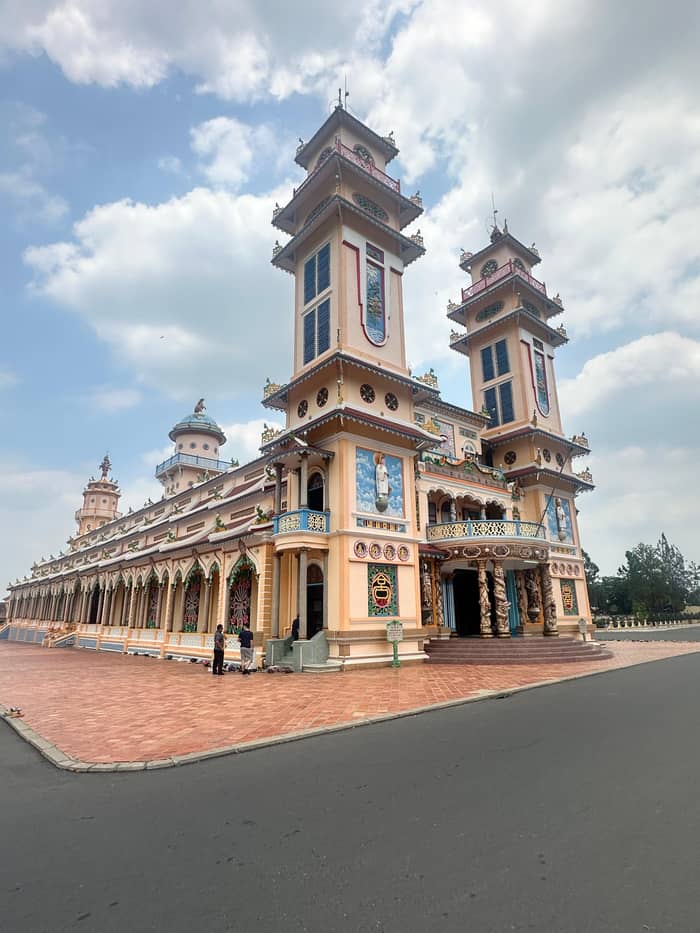
The design is credited to the spirit world rather than to an architect. A Thanh Nien article on the national portal reports that old documents describe the Holy See as modelled on the celestial realm, that no detailed drawings exist, and that its overall design and decoration reached the guardian deity Pham Cong Tac by spirit mediumship.30 Read that as the faith's own account. Nhan Dan adds that many builders were farmers with no art school behind them, and that they still produced dozens of statues and tens of thousands of carved patterns.31
The work was long and was done by followers. Vietnam.vn dates the start to 1931 and the completion to more than 20 years later, with followers as the builders and no blueprints or engineers, and it adds that the builders swore an oath of celibacy to keep yin and yang in balance within the structure.11,32 Thanh Nien dates the start to the early 1930s and the main structure to 1947, and the temple was inaugurated in 1955.12,13 Sources differ on the start, so quote the range, not a single year.
Meet the faith
Long visit
A long stop at the temple
Short visit
Temple after the mountain
Long visit
Full-day trip
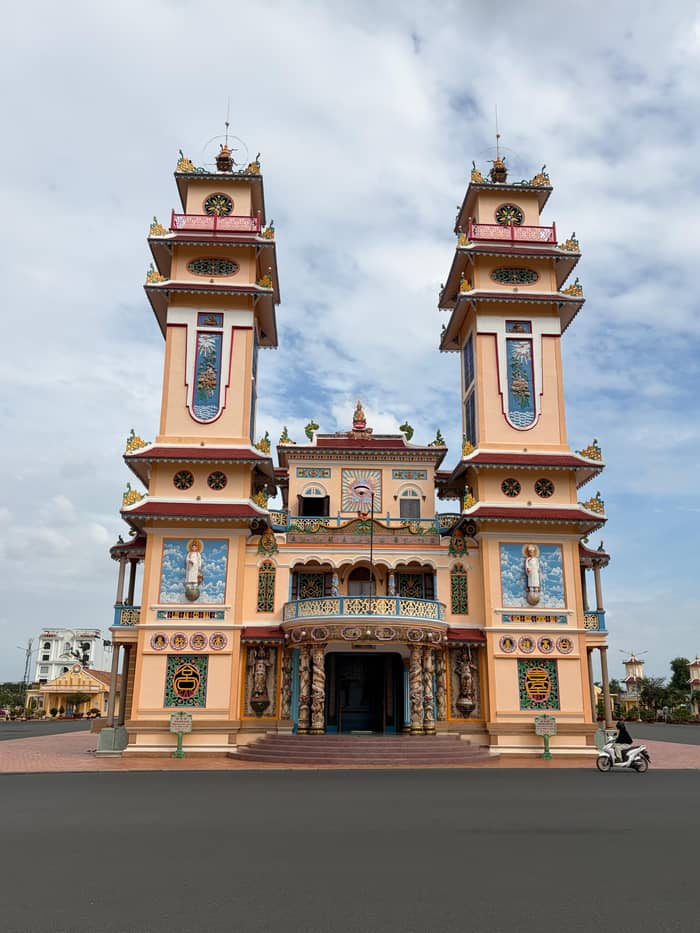
The Divine Eye comes first, because it is the sign of the faith. In Thanh Nien's account the emblem is drawn as an eye inside a triangle and stands for God.3 Vietnam News Agency sets it on a giant sphere at the centre of the main temple and reads it as the eye of heaven and the sign of the Supreme Being.24 It is also found in the main temple's own windows, and the symbol returns in more than one place on a visit.35
Numbers carry meaning as well. According to Thanh Nien, 9 is a sacred number in Caodaism, and many measurements of the temple are multiples of it.36 The state news agency describes a three-floor octagonal tower with eight walls for the eight trigrams, a symbol borrowed from Taoism.25 The roof carries a dragon-horse statue bearing a diagram of the trigrams, assembled from broken pieces of pottery and plates, a detail that shows how humble materials were used.37
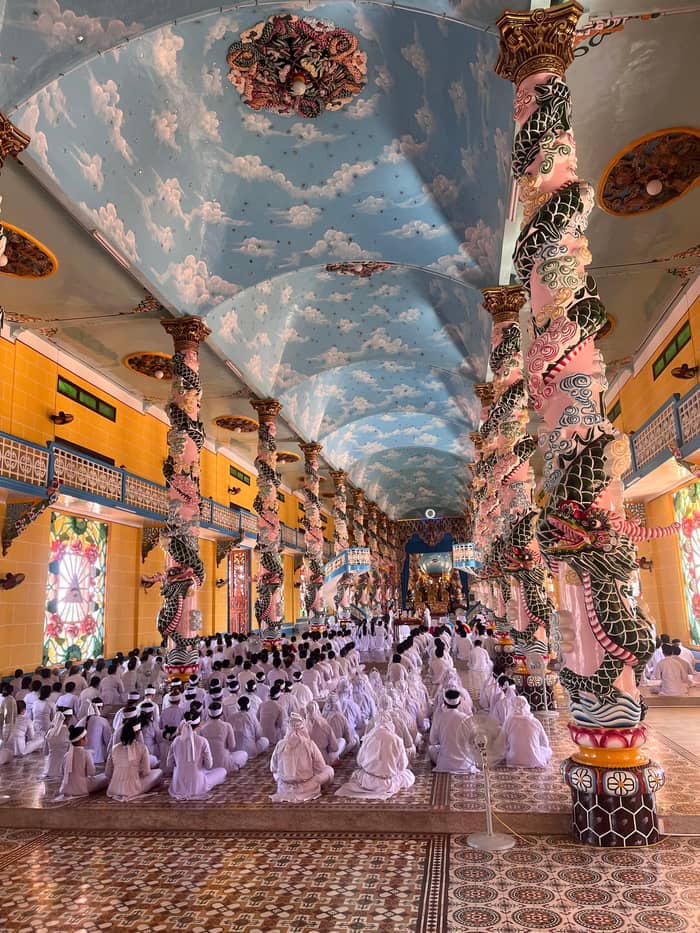
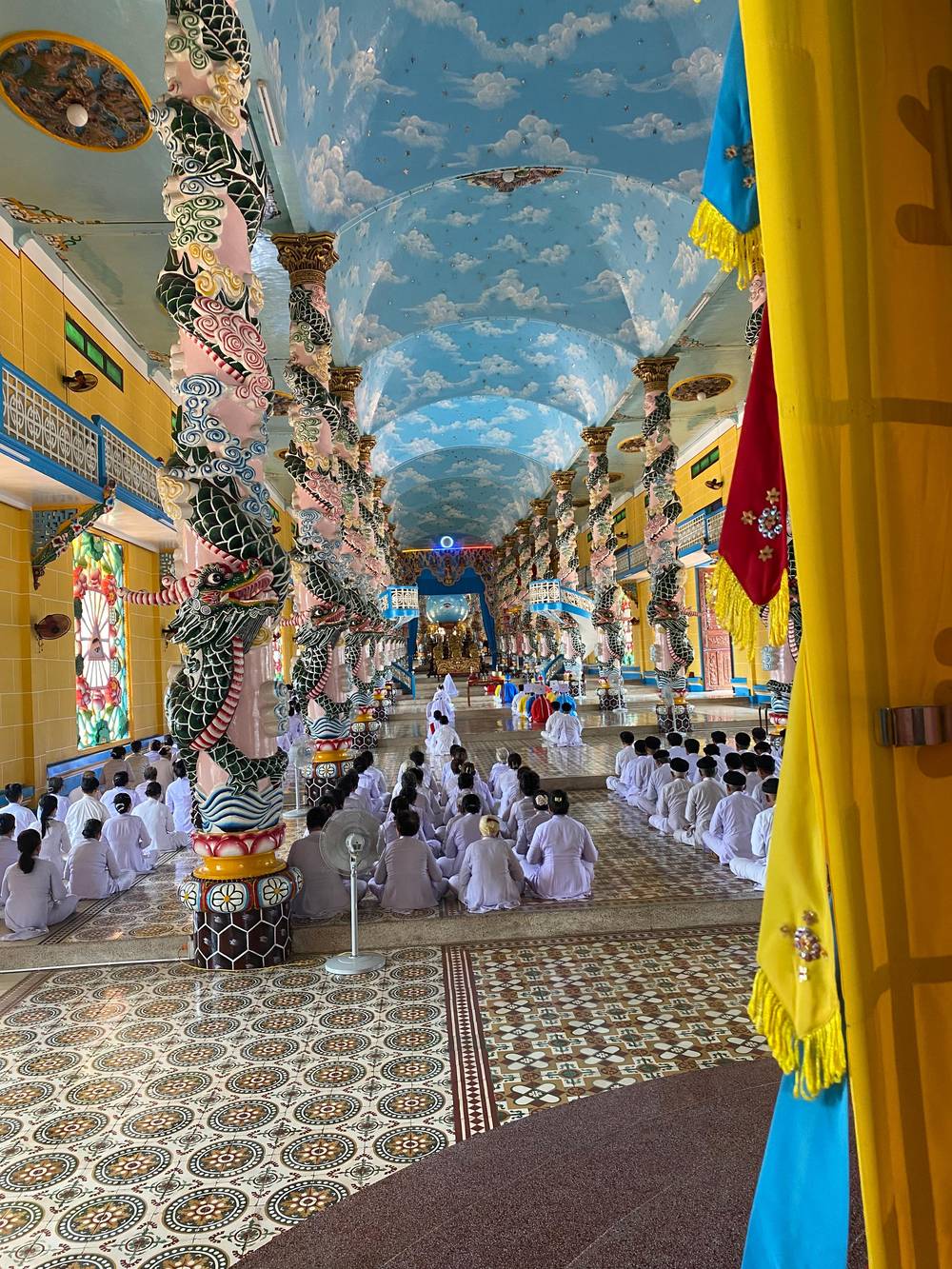
People are part of the symbolism. Festival parades in Viet Nam News's description carry the four sacred animals (dragon, kylin, tortoise and phoenix) and are joined by Cao Dai vegetarian dishes.38 The operator of the mountain notes that at the noon prayer ceremony followers wear white, yellow, blue and red robes.39 No official source used here explains what each colour stands for, so treat any confident colour code you hear as the guide's own account.
Price your visit
Enter your group and weigh up four shared days that stop at the Holy See.
Side-by-side: 4 options
Enter your group and weigh up four shared days that stop at the Holy See.
≈
View≈
View≈
View≈
ViewStarting prices from GetYourGuide, converted at the ECB reference rate. You will see the exact price when booking.
A century in order
1926
Le Van Trung and 247 Caodaists submitted the founding report.4
1931
Vietnam.vn dates the start of the Holy See to 1931 and adds that completion took more than 20 years.11
1947
Thanh Nien dates the completion of the main architectural structure to 1947.12
1955
Viet Nam News says the temple was officially inaugurated in 1955.13
1997
The Tay Ninh Congregation was recognized by the State in 1997.14
The centenary
Nam Thanh Holy Temple held a ceremony for the 100th anniversary on October 3rd.15
Counts differ by source, so set them side by side. Statistics of the Government Religious Affairs Committee, quoted by Vietnam.vn, give over 1.1 million followers and about 10,000 religious leaders.7 The Holy See page says over 2.4 million followers, and Vietnam News Agency has used about 2.5 million in Vietnam and 30,000 overseas, with 1,300 places of worship spread over 37 provinces and cities.10,21
Other figures are higher. A Tay Ninh church representative, quoted by the news agency, speaks of more than 3 million followers.8 Viet Nam News gives the Holy See as the shrine of four million followers.13 The difference is a matter of who is counted: the state statistics, a church's own figure and a general estimate are not the same measure, so cite the one you need with its source.
The religion is organised into congregations, and the state recognises them one by one. Vietnam.vn lists 10 state-recognized congregations alongside one practice method.23 Tien Thien received recognition in 1995, the Tay Ninh church in 1997 and Cau Kho and Tam Quan in 2000.14 Recognition is given by congregation, and the page of this site on Cao Dai temples looks at how that shows on the ground.
Video
Lawarch on YouTube · Video data is requested only when you tap play.
A distinctive feature of Caodaism is its synthesis of doctrines and laws from various other religions.
Before you ask
The religious year has two peaks. Viet Nam News names two largest festivals of Caodaism: one for God the Father on day 9 of the first lunar month, the other Hoi Yen Dieu Tri on day 15 of the eighth lunar month.34 Voice of Vietnam gives the Duc Chi Ton ritual as the eighth day of the first lunar month, and the dates differ by source.40 Vietnam News Agency calls Yen Dieu Tri Cung the biggest annual religious festival, with a procession of the Great Mother and Nine Goddesses.41
Daily practice follows a rhythm. In Nhan Dan's report the faithful gather for services four times a day, with the main hall reserved for them while a ceremony runs, men using the right door and women the left.33,28 A local guide quoted by Viet Nam News adds that the noon session draws the tour groups.27 The Cao Dai and Holy See pages of this site give the practical detail of where visitors stand.
Questions are welcome when they are phrased with care. Ask what a symbol means rather than whether it is true, ask how a service is organised rather than why it is held, and wait until a service has finished before you speak to a follower. Say please and thank you in Vietnamese if you can, keep your phone down while people pray, and accept that a guide may prefer to answer in general terms. A faith that built its own holy city on the Tay Ninh plain has plenty to explain.
FAQ
He is the leader named in the founding report of 1926, submitted with 247 Caodaists.4
Nhan Dan reports that the hall is kept for followers during the services.28
The festival to commemorate God the Father and Hoi Yen Dieu Tri are the two largest, on day 9 of the first lunar month and day 15 of the eighth.34
Sources
Planning a day to the Cao Dai temple from Saigon? Ask a real person here.