Long visit
Our site day
Temple, mountain, tunnels
- At the temple2 hours
- Day length12 hours
- Reviews476
Choose your stop
Check out 18 stops
Pick a route and tap a pin or a stop: you get its note and a Google Maps link.
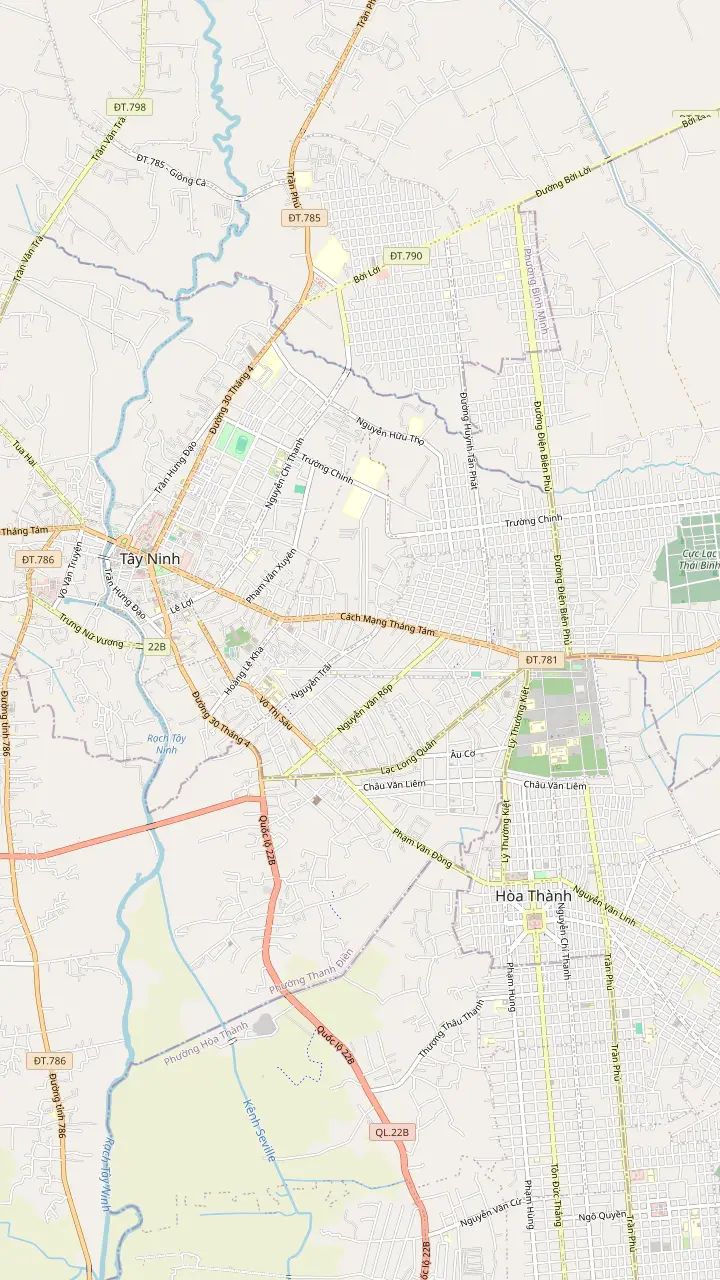
The Holy See is the heart of Caodaism, considered the religion's birthplace.
Google MapsOne of the numbered gates of the Holy Land; the compound has 12 surrounding gates.
Google MapsTay Ninh city lies about 5 km from the Holy See, the distance the state press gives.
Google Maps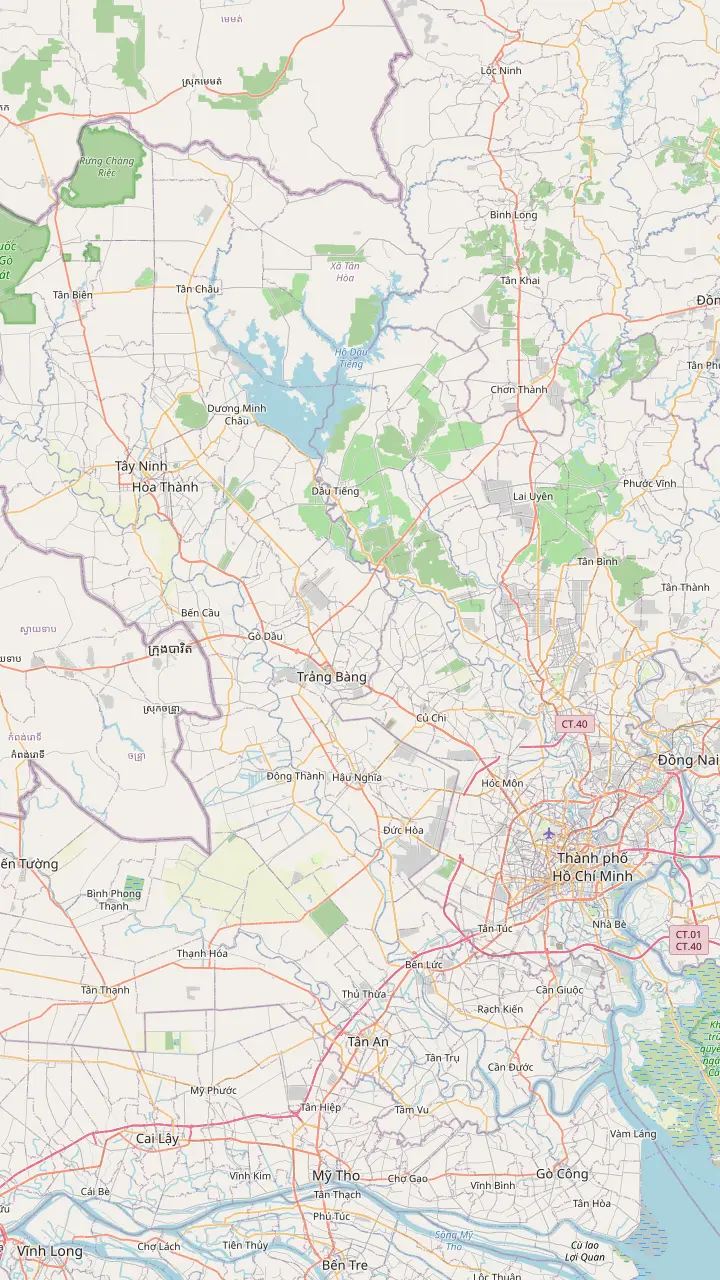
Ben Thanh Market in District 1 stands in for the pickup area that day tours use in the city centre.
Google MapsThe Ben Duoc tunnels of Cu Chi, a stop on some day tours that combine Tay Ninh with the tunnels.
Google MapsTay Ninh city lies about 5 km from the Holy See, the distance the state press gives.
Google MapsThe Holy See is the heart of Caodaism, considered the religion's birthplace.
Google MapsBa Den summit stands 986 meters above sea level, with the Lady Buddha statue on the peak.
Google Maps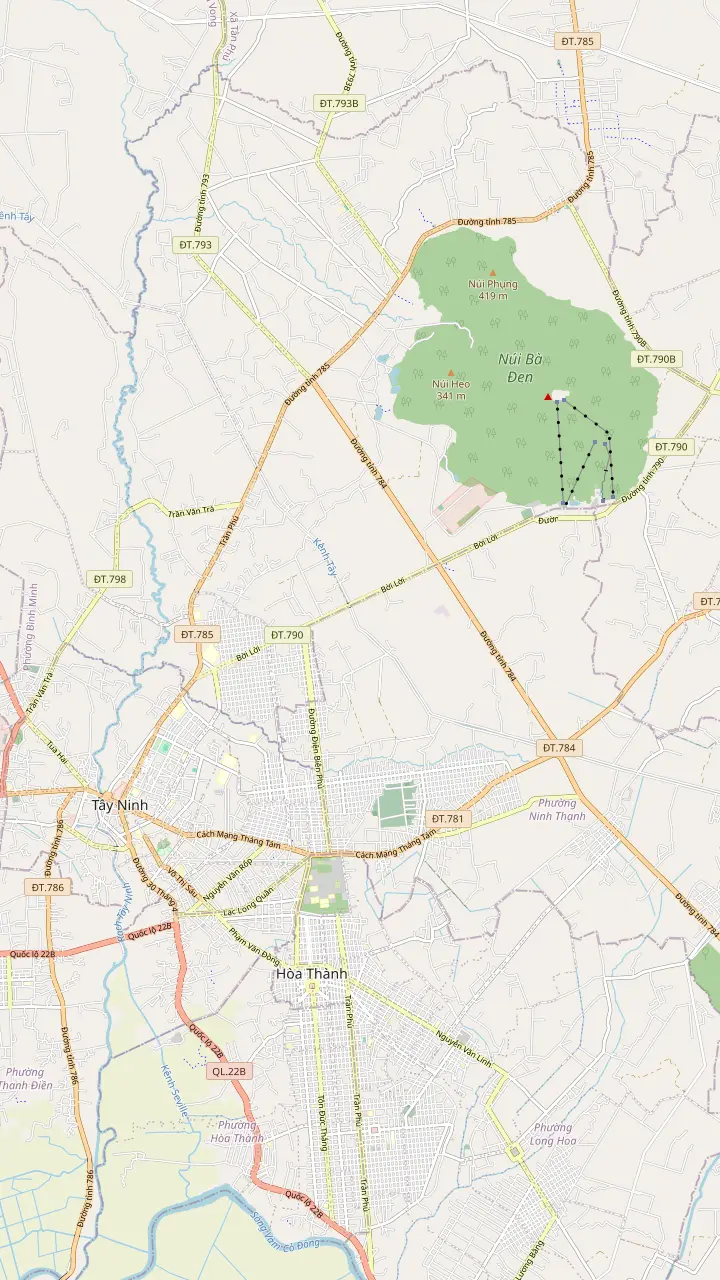
Tay Ninh city lies about 5 km from the Holy See, the distance the state press gives.
Google MapsThe Holy See is the heart of Caodaism, considered the religion's birthplace.
Google MapsThe Ba temple complex halfway up the mountain, where a cable car line and a stepped path arrive.
Google MapsBa Den summit stands 986 meters above sea level, with the Lady Buddha statue on the peak.
Google Maps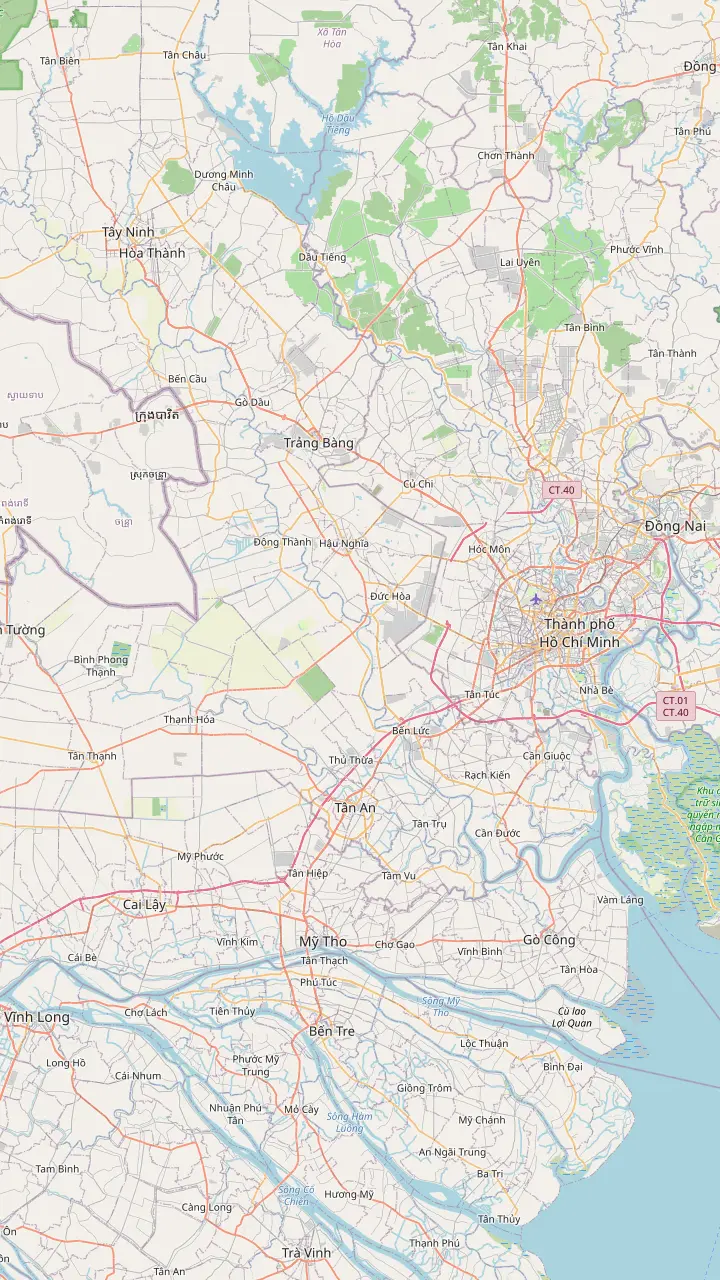
Nam Thanh Holy Temple, formerly Cau Kho, is recognised as the birthplace of the religion.
Google MapsA Cao Dai oratory in the Cho Quan ward, in the south-west of the city centre; the places a visitor can enter are decided by each oratory.
Google MapsBen Thanh Market in District 1 stands in for the pickup area that day tours use in the city centre.
Google MapsThe Holy See is the heart of Caodaism, considered the religion's birthplace.
Google MapsA Cao Dai oratory in Vinh Long province affiliated with the Tay Ninh Holy See, as its name on the map records.
Google MapsA second oratory in Vinh Long province affiliated with the Tay Ninh Holy See, as its name on the map records.
Google MapsMap data from © OpenStreetMap contributors
A walk through the building in order, from the towers and the Divine Eye to the nave, the starry sphere and the dragon-horse on the roof, with the dimensions that the sources disagree on.
Editorial team, caodaitemple.top · Updated November 16, 2026 · ~8 min read
In brief
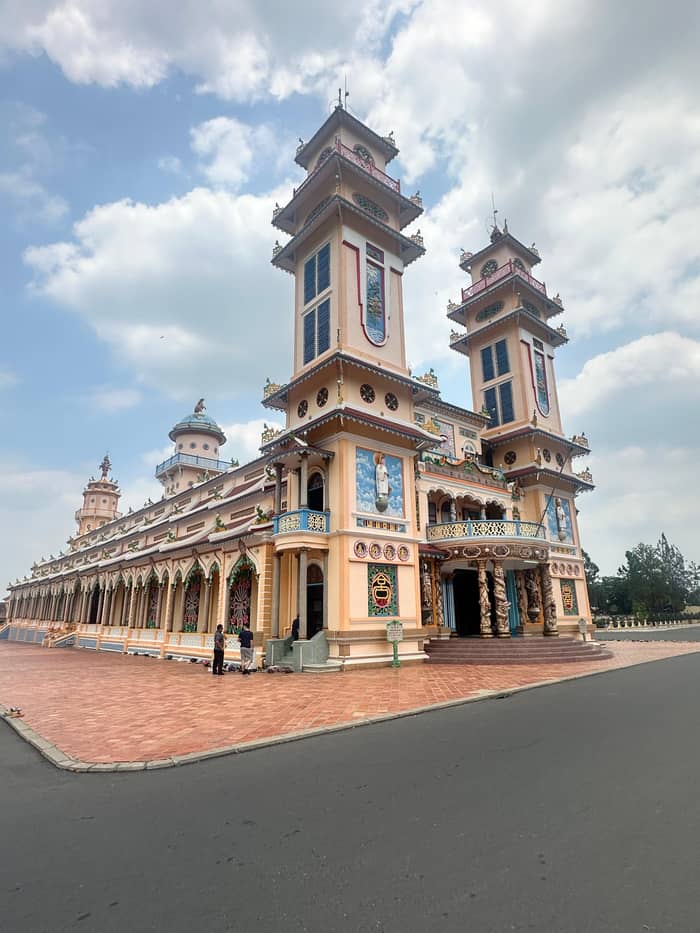
Start with the Cao Dai eye symbol at the temple, because the building is arranged around it. Thanh Nien, republished by the national portal, describes an eye set in a triangle as the Cao Dai symbol and says it represents God.1 In the main temple Vietnam News Agency finds the same sign as a giant Divine Eye on the sphere known as the Universe Globe, where it stands for the eye of heaven.7 A visitor who looks for the eye finds that it is not a single picture but a recurring mark.
It appears in the windows too. The news agency notes that the main temple's windows carry the Divine Eye as well, and Vietnam.vn adds that the window frames are decorated with lotus motifs holding a frame that depicts the eye, with an equilateral triangle around the wall of the main hall.8,9 The result is a symbol repeated at human height and at roof height, and it stays easy to find even when the interior is crowded with people in robes.
At the most sacred spot the eye sits on a sphere. Vietnam.vn says that at the centre of the Eight Trigrams Platform the Divine Eye is placed on a celestial sphere containing 3,027 stars.4 Nhan Dan gives the sphere a diameter of 3.3 metres and says it symbolises the cosmogony of the religion, in an area with a yellow roof and eight dragon pillars.10 The cosmic sphere stands where statues would stand in other temples.11
Who says what
| Source | Length | Other figures |
|---|---|---|
| Vietnam.vn (Lam Dong Newspaper) | Nearly 100 meters19 | 22 meters wide, 36 meters high19 |
| Nhan Dan | 135 metres20 | 27 metres wide20 |
| Thanh Nien via Vietnam.vn | 135 m13 | 27 m wide, main gate 36 m13 |
| Nhan Dan, main hall | 81 metres3 | 27 metres wide, 18 pillars3 |
The sources may measure different parts of the complex; quote the one you use with its name.19,20
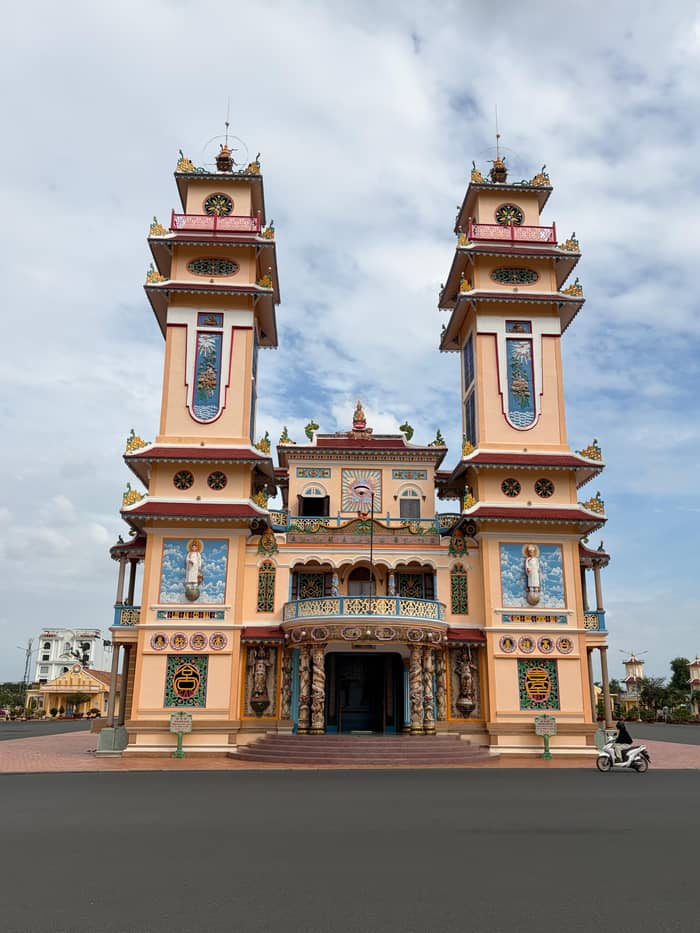
The silhouette is a story too, and Cao Dai temple architecture reads as a plan before it reads as a style. Seen from far off, the Holy See looks like a dragon-horse bowing its head, in Thanh Nien's phrase, and its roof carries a dragon-horse statue with the He Tu diagram, built from thousands of fragments of pottery and porcelain.2 Vietnam.vn describes the same roof statue, assembled from many broken pieces of pottery and plates, and says the diagram it carries is the River Diagram.15 The two articles use different names for the diagram and agree on the creature.
The plan follows a journey. The Thanh Nien account describes the interior as a passage from the visible world to the spiritual realm, from the Hiep Thien Dai at the entrance, through the Cuu Trung Dai with its nine steps, to the Bat Quai Dai where a cosmic sphere replaces statues.11 Vietnam.vn uses the same three parts and says that at its inauguration in 1955 the Holy See had three parts laid out from east to west.16 The order is the order you walk.
No drawing exists to check it against. Thanh Nien writes that the old documents liken the building to the celestial realm and keep no detailed architectural drawings, and it credits Pham Cong Tac, a guardian deity, with the whole design through spirit mediumship.17 That is the community's own account of how the plan arrived. What can be checked is the result: a structure begun in the early 1930s whose main structure was completed in 1947.18
The entrance wall is the first thing in view. Thanh Nien gives the main gate with its three-tiered platform as 36 m high and the Hiep Thien Dai, the bell and drum towers, as 27 m high, and it adds that the main gate is only opened on special occasions.13,12 The operator of the mountain describes the temple as a blend of Eastern and Western styles with soaring bell towers, a colorful facade and the Divine Eye above the faithful.23
Around it stand the gates of the compound. Nhan Dan counts more than 100 works, large and small, on an area above 1.2 square kilometres, enclosed by 12 gates that are carved with the four sacred animals and with lotus flowers.24 Vietnam News Agency also describes an octagonal tower of three floors whose eight walls stand for the eight trigrams, a Taoist borrowing.25 You do not have to see all of it to feel the scale, because the walk from a gate to the temple is itself part of the visit.
Entry follows a rule. Nhan Dan writes that men go into the main hall by the right door and women by the left, and that services run on fixed hours every day.26 Every stage of the project was built by hand, a fact that you can read in the carved dragons, lotus flowers and the many small details at close range.5 Let the staff at the gate guide you instead of choosing a door yourself, and expect the hall to be closed to non-followers while worship is under way.27
What to look for
Choose what draws you and see where in the building to find it.
If The Divine Eye
Windows and the sphere
The eye appears in the windows and on the sphere at the centre.8,7
If The dragon pillars
The main hall
The Cuu Trung Dai has 18 pillars carved with dragons.3
If The sacred sphere
The far end
The sphere stands in the Bat Quai Dai in place of statues.11
If The craft
The pillars and roof
Broken plates and pottery decorate the dragons and the roof statue.21,15
If The robes and colour
The noon service
The noon congregation wears white, yellow, blue and red.22
Time at the temple
Long visit
Temple, mountain, tunnels
Short visit
Temple before the mountain
Long visit
Mountain and temple
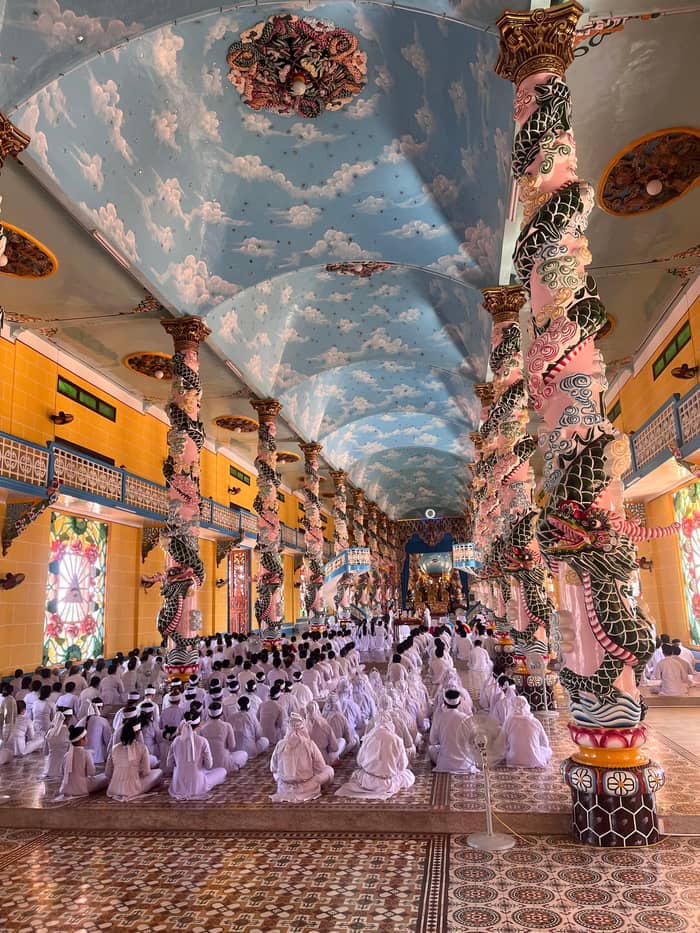
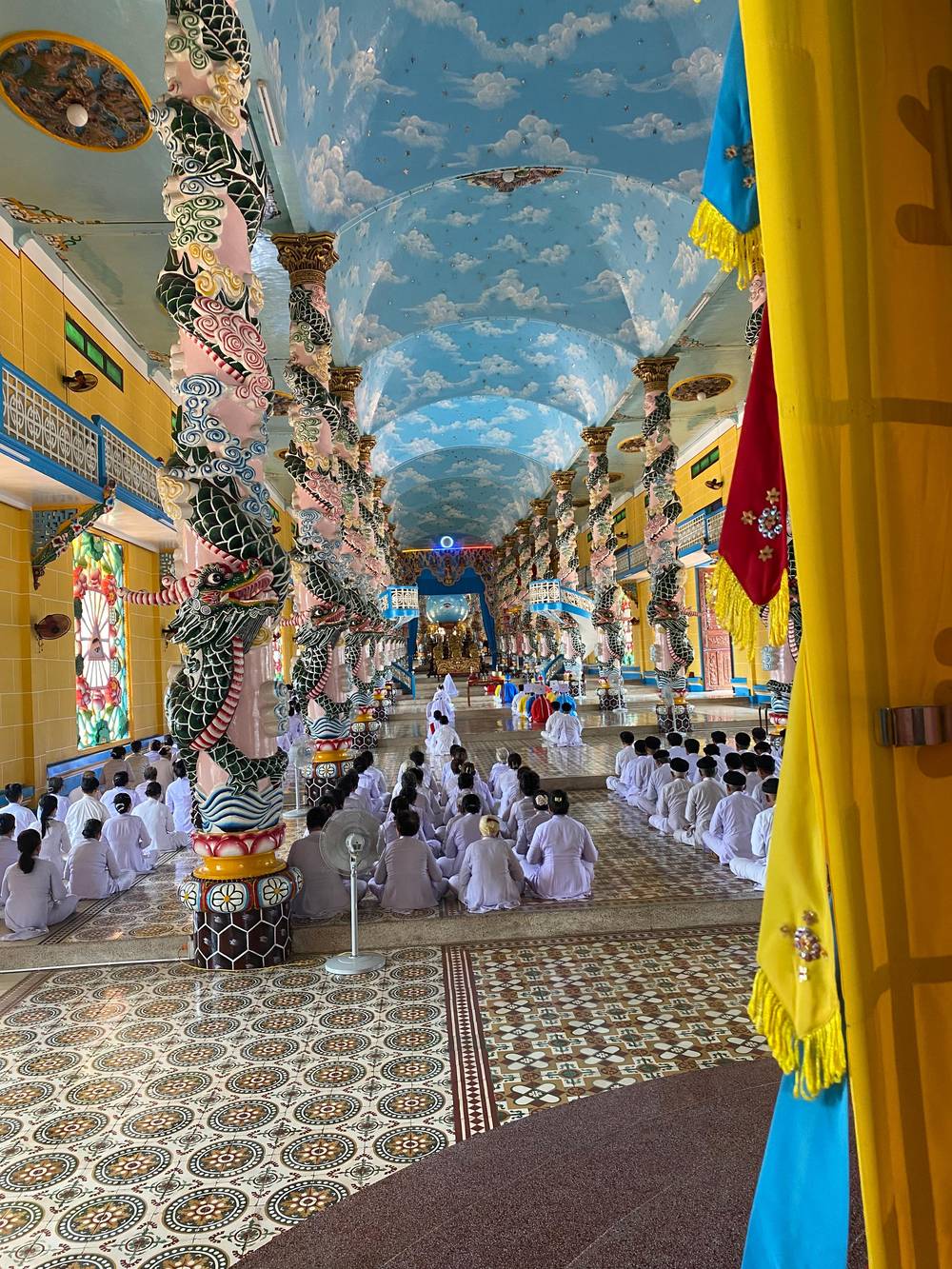
The Cuu Trung Dai is the main hall, and Nhan Dan names it the most attractive spot for visitors. It measures 81 metres by 27 metres, and 18 dragon-carved pillars divide it into nine compartments.3 Stand at the threshold first and look down the length of the hall before you move, and let the line of pillars set your pace. A ceiling painted with stars and clouds stands for the heavens, and the operator of the mountain adds a starry blue ceiling and a floor plan that follows the religion's hierarchy.36,23
Beyond the nave the platforms rise. Vietnam.vn says the Nine-Tiered Platform has seven gilded chairs for the highest-ranking officials of the religion, and that below the Eight Trigrams Platform lies a vault with six urns holding the ashes of dignitaries who helped found the faith.14,37 The most sacred area, the Bat Quai Dai, has the yellow roof, eight dragon pillars and the celestial sphere described above.10 It is the end of the walk and the point to which the eye leads you.
Colour comes from the people as well as the walls. The mountain operator describes the noon congregation in white, yellow, blue and red robes, chanting together.22 Together with the painted ceiling and the gilded chairs this gives the colorful interior of the Cao Dai temple in Tay Ninh its character. The hall is reserved for followers when ceremonies are held, so watch from where the staff place you and never cross the lines of worshippers.27
Price your visit
Set the size of your group and read off the price of four days with time inside the temple.
Side-by-side: 4 options
Set the size of your group and read off the price of four days with time inside the temple.
≈
View≈
View≈
View≈
ViewStarting prices from GetYourGuide, converted at the ECB reference rate. You will see the exact price when booking.
The walk in order
The gate
The main gate with its tiered platform is opened only on special occasions.12
The towers
The bell and drum towers stand at the entrance.13
The nave
The main hall has 18 dragon pillars and is divided into nine compartments.3
The platforms
The Nine-Tiered Platform has seven gilded chairs for the highest-ranking officials.14
The end
The most sacred area has a cosmic sphere in place of statues.11
The roof
A dragon-horse statue carries the He Tu diagram on the roof.2
The material story is as striking as the symbols. A local official quoted by Vietnam.vn lists the materials: bricks, stones and cement, but also chipped earthenware cups and plates, were set into the reliefs, the pillars and the dragon statues.21 The same official says the pillars that support the Holy See are reinforced with bamboo and rattan as well as concrete and steel.38 These are the building's own claims, repeated by the national portal, and they are worth repeating with that attribution.
The workforce was not professional. Nhan Dan counts 20 years of building, from 1926 to 1947, in five stages, all by hand and without plans, and says many workers were farmers who had never studied art.5,6 Their output ran to dozens of statues and to carved patterns counted in tens of thousands.6 The national portal adds that the builders took a solemn oath to refrain from marriage for the balance of yin and yang in the structure.39
The sources disagree on size, and the table below shows both. Vietnam.vn measures the Holy See at close to 100 meters in length, 22 in width and 36 at the highest point, while Nhan Dan and Thanh Nien give a main temple 135 metres long and 27 metres wide.19,20,13 The figures may measure different parts, and none of the sources used here explains the gap, so quote one with its source rather than combining them or repeating the larger number as fact.
Video
Traveling Kunz on YouTube · Video data is requested only when you tap play.
The all-seeing Divine Eye represents the eye of heaven and the symbol of the religion's Supreme Being.
For the visit
Plan the visit around the services. Followers keep four service hours a day, Nhan Dan notes, and Viet Nam News calls the noon session the favourite of the tour groups.26,35 The archbishop quoted by Viet Nam News says the Holy See draws 100-200 foreign tourists a day.40 A service gives you the robes and the sound, and an hour outside the services gives you the quiet and the empty light on the facade.
The facade photographs best from a distance, with the towers and the eye in one frame, and the interior photographs best when you wait for the line of robes to settle. Do not photograph worshippers at close range without asking, and never step into the nave while a ceremony is under way. If your guide offers to describe each symbol before you go in, accept, because the Divine Eye, the sphere and the dragon pillars read better once you know what to look for.
Our own day tour spends 2 hours at the Cao Dai Temple within a 12-hour day that also stops at the mountain and the Cu Chi Tunnels, and it is the listing to compare with the shorter visits. A 9-hour listing gives the temple 40 minutes before the mountain, and the one-day trip listing gives it 2 hours. Read the time given to the temple against the services, and ask the operator when the group arrives.
FAQ
Thanh Nien says the outline reads as a dragon-horse that bows its head.2
Old documents say there are no detailed architectural drawings, and the design is credited to Pham Cong Tac through spirit mediumship.17
During the ceremonies the hall belongs to the followers.27
The operator says followers wear those colours at the noon ceremony.22
Nhan Dan gives the right door to men and the left to women.26
Sources
Planning a day to the Cao Dai temple from Saigon? Ask a real person here.